
By Jermaine Thomas August 14, 2026
Serving drinks at a wedding, corporate reception, fundraiser, or private party can look straightforward from the guest side of the bar.
For the caterer, restaurant, planner, venue, or mobile bartender, however, off-site alcohol service can involve several separate legal questions: who owns the alcohol, who may sell it, which license applies, whether an event authorization is needed, who may transport the product, what training servers need, and who could face liability if something goes wrong.
Whether a caterer can legally serve alcohol at an off-premise event depends on the business’s liquor license, the event location, who purchases the alcohol, whether alcohol is being sold, the permit structure, and applicable state and local rules.
There is no single catering liquor license or special event alcohol permit that works the same way everywhere. California, for example, allows certain licensees to obtain a caterer’s permit but also requires an ABC authorization for each catered event under that permit.
Texas uses temporary-event frameworks that differ according to license type, event characteristics, and the activity being conducted. Virginia has its own caterer and banquet-license categories.
That variation is why the safest first step in serving alcohol at off-premise events is not ordering liquor or scheduling bartenders. It is identifying the event address and service model, then verifying the requirements with the state alcohol-control agency and any county, city, venue, or other authority that has jurisdiction.
This guide provides general educational information for caterers, event planners, restaurants, banquet operators, mobile bartenders, wedding professionals, venues, and private hosts. It is not legal advice, and businesses should obtain jurisdiction-specific guidance when licensing, liability, contracts, or insurance obligations are unclear.
What Counts as an Off-Premise Alcohol Event?
For catering purposes, an off-premise event generally means an event where a business is providing alcohol-related services somewhere other than its normally licensed establishment.
Common examples include weddings at barns or estates, corporate receptions at office buildings, catered dinners at private residences, fundraisers, festivals, temporary banquet locations, community celebrations, and events in rented halls.
That use of off-premise alcohol catering should not be confused with the licensing phrase “off-premises consumption.” Alcohol regulators often use “off-premises” to describe packaged alcohol sold for customers to take elsewhere.
Virginia, for example, describes a retail off-premises wine and beer license as one allowing wine and beer to be sold in closed containers for consumption away from the licensed premises.
In an event-catering discussion, the key issue is usually different: a restaurant, caterer, bartender, or beverage company is leaving its normal place of business and participating in alcohol service at another location.
That distinction matters because a restaurant license that authorizes alcohol service inside one restaurant does not necessarily travel with the restaurant’s employees.
Some jurisdictions create a specific catering privilege, endorsement, authorization, or temporary-event procedure for activities away from the primary licensed premises. California’s Type 58 system is one example: eligible licensees obtain a caterer’s permit and then seek authorization for individual catered events.
Event type also matters. An invitation-only wedding may be regulated differently from a ticketed festival. A hosted corporate reception may raise different questions from a cash bar, and a nonprofit fundraiser may have permit options that are unavailable to a for-profit organizer.
For broader event logistics beyond beverage compliance, businesses can also review this wedding catering planning guide and guidance on coordinating catering teams with event planners. Both reinforce why venue rules, schedules, staffing, bar service, and vendor responsibilities should be addressed before event day.
Can a Caterer Serve Alcohol Off-Site?
A caterer may be able to sell or serve alcohol away from its primary premises, but the authority must come from the applicable license and event rules. A food-catering license, business license, food-service permit, or bartender certificate does not by itself establish authority to sell alcoholic beverages.
Several regulatory models appear across different jurisdictions. A licensed restaurant may qualify for a catering endorsement or permit that extends certain privileges off-site. A regulator may require event-by-event authorization.
An event organizer may qualify for a temporary or special-event license. In another arrangement, the host may purchase alcohol while bartenders provide service only, subject to applicable laws governing that model.
A separately licensed beverage caterer can also be involved. Virginia, for example, states that its mixed beverage caterer license authorizes qualifying licensees to sell and serve alcoholic beverages for on-premises consumption at private gatherings or special events.
California, by contrast, expressly limits eligibility for its Type 58 caterer’s permit to specified existing license categories and requires authorization for catered events.
These examples demonstrate why caterer liquor license requirements cannot safely be reduced to “get a catering liquor license.” The actual license structure, event approval, alcohol privileges, and eligible locations must be checked in the jurisdiction where the event occurs.
Catering Privilege or Endorsement vs. Temporary Event Permit
A catering privilege usually attaches in some way to an existing alcohol license. A temporary liquor permit or special event alcohol permit, by comparison, is often connected to a particular event, applicant, location, or set of dates. The names and legal effects vary substantially.
California illustrates the two-level concept clearly. Its Type 58 caterer’s permit gives certain licensees access to off-site catering privileges, but the licensee must still obtain ABC authorization for each catered event. The regulator also notes that an application and payment do not constitute automatic approval.
Texas illustrates a different system. TABC describes temporary event authorizations for eligible licensees and organizations, with the required process depending on the permit holder and event. Certain qualifying activities use notification procedures, while other temporary events require authorization before alcohol may be sold or served.
| Requirement | Catering Privilege/Endorsement | Temporary/Special Event Permit |
| Typical purpose | Extends qualifying alcohol privileges beyond the main premises | Authorizes activity connected with a particular event |
| Tied to existing license | Often, but jurisdiction dependent | Sometimes |
| Event-specific approval | May still be required | Usually event-specific by design |
| Location restrictions | Common | Common |
| Alcohol types covered | Depends on underlying privilege | Depends on permit |
| Advance filing possible | Frequently | Frequently |
| Local approval possible | Yes | Yes |
The table is a planning framework, not a description of one jurisdiction’s law.
Questions to Answer Before Accepting the Event
Before quoting alcohol service, a caterer should identify the exact license it holds and ask the regulator whether that license authorizes the proposed off-site activity. Do not rely solely on the fact that a business has an on-premise restaurant license.
Confirm whether each event requires separate approval, whether the proposed venue is eligible, and whether beer, wine, and distilled spirits receive the same treatment. Some licenses authorize narrower product categories than others.
Also determine whether the event is public or private, whether admission or drink charges are involved, and whether another alcohol license already covers the location. In California, ABC notes that the location of a catered event can affect the approval process and that restrictions associated with the site can remain relevant.
Who Can Purchase, Own, and Transport the Alcohol?

Who buys the alcohol is one of the most important questions in off-site alcohol service. The fact that a client paid for an event does not automatically determine who may legally purchase the beer, wine, or spirits, and changing the purchaser can change the regulatory model.
Businesses should map four separate roles for every event: purchaser, owner, transporter, and server. The same party may fill all four roles, or several businesses and individuals may be involved.
Caterer Purchases the Alcohol
A licensed alcohol caterer may be permitted to purchase product through authorized channels and provide it under the privileges of its license. Whether it may do so, where the inventory can be stored, and how it can be transported depend on the applicable licensing system.
The caterer should confirm that its license covers the specific beverages being provided and that the event authorization is effective for the location and service period. Purchasing alcohol first and trying to resolve the permit later is a poor compliance practice.
California’s catering rules illustrate how specific these privileges can become. ABC explains that qualifying catered-event licensees exercise only the privileges authorized by their license and that event-site rules can affect possession and storage.
Invoices and purchasing records should identify the licensed business and be retained with the event file when required or useful for demonstrating lawful acquisition.
Client Purchases the Alcohol
Another model is for the event host to purchase the alcohol and hire bartenders or caterers to pour it. This arrangement can be lawful in some circumstances, but client-supplied alcohol does not automatically eliminate licensing, service, venue, or liability concerns.
California ABC, for example, specifically explains in its licensing FAQ that hired bartenders cannot simply operate as unlicensed caterers by bringing alcohol, charging by the glass, purchasing alcohol for reimbursement, or taking prepaid alcohol orders. In the scenario described by ABC, the host must purchase the alcohol in advance.
That example should not be exported to another jurisdiction as a nationwide rule. Instead, it demonstrates why businesses need to confirm what an unlicensed bartender may and may not do.
The service company should also determine whether charging for “bar service,” an alcohol package, corkage, guest tickets, or another component could legally be treated as selling alcohol rather than merely providing labor.
Venue Purchases or Supplies the Alcohol
If the venue already holds a liquor license and supplies the alcohol, its license terms may control much of the transaction. Caterers and planners should obtain a clear understanding of who operates the bar, whose employees serve, where service may occur, and whether outside alcohol is prohibited.
A venue may also have exclusivity provisions requiring use of its beverage program or an approved vendor. Those contract rules are separate from government licensing requirements but can be equally important to event operations.
Do not assume that the caterer can add its own inventory simply because the building is already licensed. Some regulators impose specific procedures when an off-site caterer operates at a licensed location. California, for example, has rules addressing catered events held at licensed sites.
Transporting and Storing Alcohol
Alcohol transportation rules can depend on the person transporting the product, ownership, license type, product source, destination, and purpose of the trip. Some privileges expressly include transportation; other situations require different authority.
The correct questions include:
- Who owns the alcohol while it is in transit?
- Who purchased it and from whom?
- Does the license authorize transportation to the event?
- May the wholesaler deliver directly to the authorized site?
- Are there requirements governing invoices or shipping documents?
- Where may alcohol be stored before service?
- What happens to unopened product after the event?
California ABC, for example, states that wholesalers may deliver alcoholic beverages to an authorized catered-event site and imposes particular restrictions on distilled-spirit storage at such sites.
New York’s Liquor Authority likewise demonstrates how transportation authority can become license-specific by identifying transportation requirements for certain permit activities.
At the event, keep inventory in a controlled area rather than in guest-accessible coolers, unattended boxes, or open storage rooms. Track opened and unopened products, restrict access to authorized staff, and maintain appropriate temperature controls for beverages where product quality or safety requires them.
Selling Alcohol vs. Merely Serving Alcohol
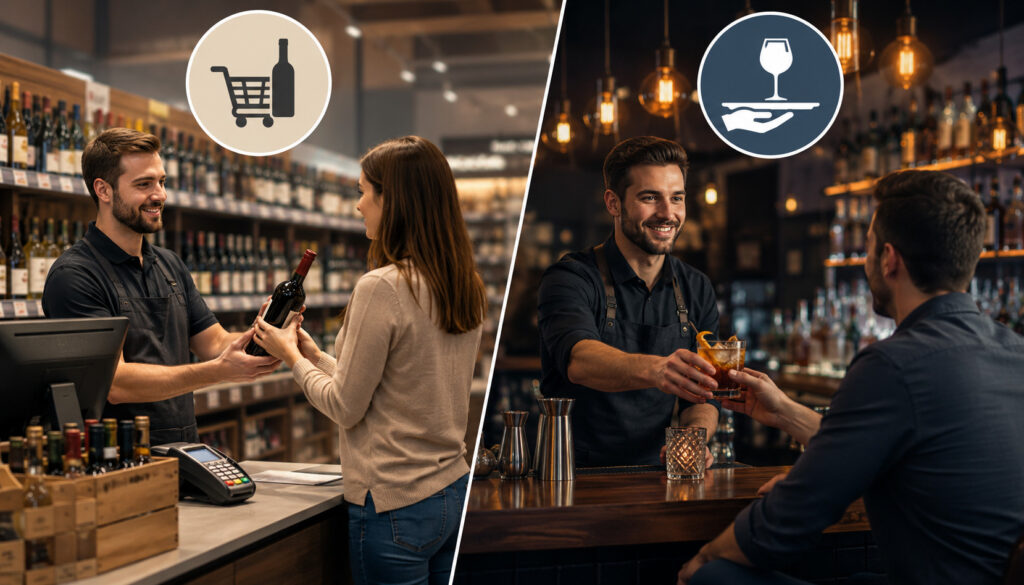
Selling alcohol and serving alcohol are related activities, but they are not always legally identical. A bartender can physically pour a beverage without personally completing a retail sale, while another business may be the licensed seller responsible for the transaction.
The payment structure therefore needs to be examined before the event. Regulators may consider more than whether cash changes hands at the bar.
A direct per-drink payment is an obvious sale model. Other arrangements that deserve review include drink tickets, admission that includes alcohol, per-person beverage packages, prepaid bar packages, mandatory “donations,” membership fees connected with drinks, and other charges through which the guest or host pays for alcoholic beverages.
Texas TABC, for example, emphasizes that selling alcohol without the appropriate license or permit is unlawful and advises businesses to examine the privileges of their specific license or temporary-event authorization.
Cash Bars
A cash bar generally means individual guests purchase drinks. Because there is a direct alcohol transaction, the business operating the bar should verify that its license and event authorization allow the proposed sale at that location.
Do not solve the licensing question by placing someone else’s name on the cash box or payment terminal. Regulators may consider who controls inventory, pricing, sales, staffing, and proceeds rather than only who physically accepts payment.
For event planners, the useful question is: Which legally authorized entity is actually selling the drinks? That party should be identified before invitations, menus, ticketing pages, or bar packages describe alcohol sales.
A mobile bartender who is only qualified to provide labor should not be presented as a licensed alcohol retailer unless the business actually holds the required authority.
Open Bars and Hosted Alcohol
An open bar normally means individual guests are not charged at the point of service. That does not necessarily make alcohol regulation irrelevant.
The host may have purchased the beverages directly, or a licensed caterer may be selling a beverage package to the host. Alcohol might also be bundled into a wedding package, admission price, catering contract, or venue charge.
The legal treatment depends on the jurisdiction and transaction. Therefore, businesses should avoid the simplistic rule that “free drinks need no license.”
Document who purchased the alcohol, who is being paid for alcohol service, whether alcohol costs are part of a package, and which entity holds the authorization for the event. That analysis should be completed before invoices and contracts are structured.
Temporary Permits, Public Events, Private Events, and Venue Rules

A private wedding and a public festival can involve very different regulatory risks even when the same bartender pours the same drink. Public access, ticket sales, charitable fundraising, the type of applicant, venue status, alcohol products, attendance, and event duration can all affect which event authorization is available.
Virginia illustrates this distinction with several different license categories. Its banquet special-event license applies to qualifying nonprofit organizations conducting public or private events for specified purposes, while its mixed beverage caterer license addresses commercial catering privileges.
A regulator may request information about the applicant, event address, dates, hours, alcohol categories, property authorization, site diagram, security, or local approvals. Businesses should use the current agency application rather than relying on an old blog post or a permit obtained years earlier.
Lead times also vary and can change. For example, California currently publishes a filing window for its Type 58 catering authorization, while New York publishes a separate advance-filing rule for its catering permit. These deadlines demonstrate jurisdictional variation rather than a universal event-permit timeline.
Why Public vs. Private Status Matters
An invitation-only anniversary party is not operationally the same as a street festival open to anyone who purchases admission. Regulators may define or treat private events differently from public ones, and nonprofit events can have permit categories unavailable to ordinary commercial hosts.
Texas provides a useful illustration. Its current temporary-event framework includes conditions that distinguish certain private events from other temporary activities, while Virginia separately identifies special-event licenses for qualifying nonprofit organizations.
Do not label an event “private” simply because it takes place on private property. Verify the regulator’s criteria.
Advertising, unrestricted ticket sales, attendance limits, organizational eligibility, fundraising structure, and public access may all matter depending on jurisdiction.
Venue Rules Can Be More Restrictive Than the Event Plan
Before accepting a bar assignment, confirm whether the venue already holds an alcohol license and whether outside alcohol is allowed. Ask for the venue’s current alcohol policy and determine which spaces are approved for drinking and service.
Review exclusivity clauses, outside-vendor rules, bar locations, guest-entry procedures, service hours, security requirements, cleanup responsibilities, and rules for leftover alcohol. A venue may prohibit an activity even where government law would otherwise allow it.
Bartender Certification and Responsible Alcohol-Service Requirements
“Bartender certification” is commonly used as if it were one legal credential. In practice, it can refer to several very different things.
A private bartending school may issue a completion certificate showing that a person learned drink preparation and bar skills. A state-approved program may provide legally recognized responsible beverage service training. Another jurisdiction may require a server permit or certification for specified alcohol-service employees.
None of those credentials should be confused with the business liquor license that authorizes alcohol sales.
Mandatory Alcohol-Server Training
Some jurisdictions require approved alcohol-server education for people performing covered duties. California ABC states that on-premises alcohol servers and their managers, including covered caterers, must satisfy its Responsible Beverage Service program requirements.
Washington requires Mandatory Alcohol Server Training for people who serve, mix, sell, or supervise alcohol sales for on-premises consumption, subject to the program’s rules.
Other states may structure training differently. Virginia ABC, for example, offers responsibility training and explains benefits available when licensees demonstrate qualifying training, illustrating that training regimes do not operate identically across jurisdictions.
Before staffing an event, verify whether each bartender, server, manager, or ID checker falls within the applicable training requirement and whether the credential remains valid.
Voluntary Bartender Certification and Employer Training
A private bartending course can be useful for teaching beverage preparation, customer service, equipment setup, recipes, and bar operations. It does not automatically satisfy a government alcohol-server training mandate.
Likewise, completing a server-training course does not give a person authority to open a cash bar. Bartender certification is not a substitute for a liquor license or event permit.
Good employers also go beyond minimum credential requirements. Event-specific training should explain who has authority to refuse service, where guests may consume alcohol, which IDs are accepted under applicable rules, how suspected fake IDs are handled, who contacts security, and how incidents are documented.
Training should be refreshed when staff work in unfamiliar venues or under different licensing arrangements.
Age Verification, Intoxication Controls, and Responsible Service
Responsible alcohol service at private events deserves the same operational discipline as service in a permanent restaurant or bar. Weddings and catered parties can create additional challenges because guests may know the host, bring drinks from another area, move between bars, or pressure staff to make exceptions.
The objective is not for a bartender to estimate a guest’s blood alcohol concentration from observation. Staff should instead follow the law, company policy, and their approved training while watching for observable conduct that may require slowing or refusing service.
Age Verification and Preventing Service to Minors
The drinking age does not become optional because an event is invitation-only. Businesses should establish an age-verification process consistent with the jurisdiction’s rules and the type of event.
Depending on the setting, controls can include checking acceptable government-issued identification, restricting bar access, using event wristbands after proper age checks, creating separate alcohol-service zones, and requiring bartenders to recheck identification when there is uncertainty.
Wristbands should support, not automatically replace, bartender judgment. They can be transferred or misused.
California ABC’s catered-event guidance, for example, makes clear that people under 21 may be present in some catered-event settings while remaining prohibited from purchasing, possessing, or consuming alcohol. Washington law likewise prohibits furnishing liquor to people under 21 subject to statutory exceptions.
Event hosts should never instruct bartenders to overlook age requirements because a guest is a relative, wedding-party member, donor, or VIP.
Recognizing Intoxication and Refusing Service
Possible warning signs can include deteriorating coordination, significant behavioral changes, difficulty communicating, impaired balance, aggression, unusual drowsiness, repeated drink-seeking, or other observable indicators addressed in approved server training.
No single sign proves intoxication, and behavior can have causes unrelated to alcohol. Staff should use their training, involve managers when appropriate, and avoid making medical conclusions.
A refusal policy should establish who can stop service, how servers call a manager, when security becomes involved, and how the team prevents a guest who was refused at one bar from obtaining drinks at another.
Provide abundant water, appealing nonalcoholic beverages, food when appropriate to the event, and safe transportation options. These measures support guest welfare but do not eliminate legal duties surrounding unlawful or unsafe service.
Dram Shop Liability and Social Host Liability
Dram shop liability generally refers to laws under which an alcohol provider may face civil liability in specified circumstances connected with providing alcoholic beverages and subsequent injury. The exact cause of action, protected parties, evidentiary standard, defenses, exceptions, and relationship to common-law claims vary considerably by jurisdiction.
There is no nationwide rule that a caterer automatically becomes liable whenever an intoxicated guest causes an accident. There is likewise no safe rule that a caterer can never be responsible once the guest leaves the venue.
Texas provides one example of a statutory framework. Its Alcoholic Beverage Code creates a cause of action under specified circumstances involving a provider and an individual whose intoxication was apparent to the statutory degree and whose intoxication was a proximate cause of damages.
The same chapter separately addresses particular circumstances involving adults who knowingly provide alcohol to minors. Those elements are Texas-specific. Caterers operating elsewhere must review the statutes and case law applicable to the event.
Dram Shop Liability for Caterers
A commercial caterer or beverage provider can fall within alcohol-provider liability rules when the relevant statute covers the entity and the facts satisfy its requirements. Off-site service does not necessarily insulate a licensed operator from claims.
Consider a catered reception where the alcohol provider controls the bar, bartenders, inventory, and service decisions. If an alcohol-related injury later results in litigation, investigators and attorneys may examine who served the guest, what staff observed, whether alcohol went to a minor, what company procedures required, whether refusals occurred, and what records exist.
Three points are particularly important:
- Licensing compliance does not automatically eliminate civil liability.
- Responsible alcohol-service training does not guarantee immunity.
- Insurance does not eliminate the insured’s legal duties.
Conversely, a claim does not automatically mean the caterer violated a dram shop statute. Liability remains dependent on jurisdiction-specific law and facts.
Social Host Liability
Social host liability concerns potential responsibility associated with a person who provides or permits alcohol in a social setting rather than acting as a commercial licensed alcohol seller. States differ significantly in whether such liability exists and when it applies.
The distinction becomes especially important at weddings and private parties where a host buys the alcohol but hires professionals to serve it. The host, caterer, bartender, and venue may occupy different legal roles, and one party’s involvement does not necessarily eliminate another party’s obligations.
Texas’s statute illustrates this separation by defining “provider” for its commercial-liability framework while separately addressing specified adult conduct involving provision of alcohol to minors.
Businesses should therefore avoid telling a client, “Because you bought the liquor, all liability is yours.” That conclusion may be incorrect under the applicable law or the facts.
| Issue | Commercial Alcohol Provider | Social Host |
| Licensing role | Often operates under alcohol licensing authority | May not be a commercial licensee |
| Sale/service for profit | Frequently part of the business activity | Usually social rather than retail activity |
| Liability framework | May involve dram shop statutes or other applicable law | May involve separate social-host statutes or doctrines |
| Minor-service concerns | Potentially significant | Potentially significant |
| Intoxicated-guest concerns | Depends on governing law | Depends on governing law |
| Rules vary by jurisdiction | Yes | Yes |
Liquor Liability Insurance, General Liability, and Host Coverage
Insurance should be reviewed before alcohol is added to an off-site catering package. A certificate showing that a caterer has “general liability” insurance does not by itself prove that every alcohol-related claim at every temporary event is covered.
Policy language, exclusions, endorsements, definitions, locations, insured parties, subcontractors, and factual circumstances determine coverage. Businesses should discuss their specific operations with a qualified insurance professional and review the actual policy rather than relying only on a certificate.
Liquor Liability vs. General Liability
Liquor liability insurance is designed to address certain alcohol-related liability exposures subject to the policy’s terms, exclusions, conditions, and limits. Depending on the policy, relevant claims may involve bodily injury, property damage, and defense expenses.
A commercial general liability policy may contain exclusions or limitations affecting businesses engaged in furnishing alcoholic beverages. That makes it dangerous to assume the general liability policy automatically provides all required protection for an alcohol caterer.
Before an event, ask:
- Does the policy cover off-site alcohol catering?
- Are temporary event locations included?
- Does it cover the alcohol activities actually being performed?
- How are subcontracted or independent bartenders treated?
- Are defense expenses handled within or outside policy limits?
- Does the contract require additional insured status?
- Must the venue, host, landlord, or planner be added?
- Are the limits sufficient to meet contractual requirements?
- Are there exclusions relevant to minors, assault, transportation, or particular event types?
Answers should come from the insurer, broker, or policy documents rather than assumptions.
Host Liquor Liability
Host liquor liability generally refers to insurance protection for certain alcohol-related exposures of an organization that provides alcohol incidentally rather than operating as a business engaged in selling or serving it.
That distinction matters. A business whose core or regular operations include alcohol sales or alcohol service should not assume a host-liquor feature substitutes for appropriate liquor liability coverage.
Likewise, the fact that a wedding client bought the alcohol does not automatically mean the caterer’s only possible exposure is covered through the client’s policy.
The safest approach is to describe the exact event arrangement to the insurance professional: who buys the alcohol, who serves it, who charges for it, who employs the bartenders, where the event occurs, and whether subcontractors participate.
Contracts, Staffing, Security, Transportation, and Event Operations
Licensing answers should be translated into written event responsibilities. Otherwise, the caterer may assume the venue is checking IDs while the venue believes the bartender is doing it, or the client may believe the caterer is purchasing alcohol when the caterer quoted labor only.
The contract need not reproduce the alcohol code. It should accurately identify operational responsibilities and avoid promising activities the business is not authorized to perform.
Important topics include who purchases alcohol, who obtains permits, who employs bartenders, who verifies IDs, who controls service, service hours, cutoff procedures, insurance requirements, leftover inventory, incident escalation, cancellation, and the parties responsible for complying with venue requirements.
Indemnification and other legal risk-allocation provisions should be reviewed by qualified counsel rather than copied from an online template.
Subcontracted Bartenders and Mobile Bartending Services
Hiring an independent bartender does not automatically transfer a caterer’s regulatory responsibilities. The parties need to determine which business is selling alcohol, which license covers the transaction, who employs or supervises the server, and whether the subcontractor has the insurance and training required by law and contract.
A mobile bartending license is also not a single universal credential. Depending on the jurisdiction and business model, an independent bartender may only be providing labor, while a licensed beverage caterer may have legal authority to purchase and sell alcohol under specified conditions.
California’s licensing FAQ gives a useful example by distinguishing hired bartenders from licensed caterers and restricting alcohol purchasing and sales activities by hired bartenders in the circumstances described by the agency.
Verify the business model rather than relying on marketing terms such as “mobile bar,” “dry hire,” or “bartending service.”
Event Planners, Security, and Crowd Management
An event planner can coordinate alcohol compliance without becoming the alcohol retailer. Planners should confirm which licensed entity is responsible, collect required documentation, coordinate permit deadlines, and ensure the venue and alcohol provider are working from the same service plan.
Large events may require additional crowd-management measures. Entry controls, dedicated security, restricted bar zones, clear paths for emergency services, and communication between bartenders and security can become important when attendance or venue design increases risk.
If a bartender refuses service, security personnel should understand the procedure for preventing harassment, drink-sharing, or attempts to use another bar. Managers should also know when emergency medical assistance or law enforcement is appropriate.
Event staff should never treat security as a substitute for responsible alcohol service.
Quantity Planning, Last Call, and Transportation
Alcohol quantity planning should support controlled service rather than encourage excessive consumption. Consider guest count, event duration, drinking-age attendance, meal timing, beverage variety, nonalcoholic options, and the ability to secure excess inventory.
Avoid creating incentives for staff to “finish the bottles” before the reception ends. Excess product should be handled according to the ownership, licensing, transportation, venue, and storage rules that apply.
Set a documented last-service and bar-closing procedure consistent with the jurisdiction, permit, venue policy, and event contract. Do not rely on a universal closing hour.
Designated drivers, taxis, rideshare availability, hotel shuttles, and scheduled event transportation can help reduce risk. Transportation planning is valuable, but it does not excuse unlawful service to a minor or service prohibited by applicable intoxication rules.
Documentation and the Off-Premise Alcohol Event Compliance Checklist
Good records help a business prove what was authorized, who performed the work, and how an unusual incident was handled. Documentation should begin before the first bottle arrives and continue through event closeout.
Depending on the jurisdiction and event, a file may include the business liquor license, catering authorization, temporary permit, venue agreement, property authorization, alcohol invoices, server-training records, insurance certificates, staffing list, client contract, security plan, and approved site diagram.
Do not invent a retention period. Some documents may be subject to regulatory, insurance, tax, employment, or contractual retention rules, and those rules should be verified for the business.
Incident records deserve particular care. Record relevant facts surrounding refused service, questionable identification, intoxication concerns, guest injuries, security intervention, emergency medical response, and manager decisions. Keep reports factual and avoid collecting unnecessary personal information.
| Item | What to Verify | Responsible Party |
| Business liquor license | License type and off-site privileges | Licensed operator |
| Event permit | Whether event-specific approval is required and obtained | Permit holder |
| Venue authorization | Outside alcohol, licensed areas, service restrictions | Venue/planner |
| Alcohol purchaser | Who may legally acquire the product | Licensed party/host |
| Transportation rules | Who may transport, from where, and under what authority | Alcohol owner/licensee |
| Bartender training | Required government-approved credentials and validity | Employer/licensee |
| Age verification | Accepted IDs and event control procedure | Bar manager/servers |
| Liquor liability insurance | Off-site activity, limits, exclusions, insured parties | Business/insurance adviser |
| Service cutoff | Legal, permit, venue, and contract requirements | Manager |
| Incident plan | Refusals, security, emergencies, transportation | Caterer/venue/planner |
| Documentation | Permits, invoices, contracts, training, reports | Designated recordkeeper |
Step-by-Step Process for Serving Alcohol at an Off-Premise Event
A consistent process helps prevent the most common alcohol catering mistakes. The goal is to resolve licensing and responsibility questions before pricing, purchasing, transporting, or promoting the bar.
- Identify the exact event location and type: Record the full address, venue name, event date, whether access is public or invitation-only, expected attendance, and the host or sponsoring organization.
- Map every alcohol-related role: Determine who sells, purchases, owns, transports, stores, pours, supervises, verifies IDs, and receives alcohol-related revenue.
- Verify the caterer’s existing license: Check the actual license type with the alcohol-control authority. Do not assume an ordinary restaurant or food-catering credential extends off-site.
- Determine whether event-specific authorization is required: Confirm whether the applicable framework uses a catering endorsement, temporary event authorization, special-event license, banquet license, or another mechanism. California’s Type 58 system and Texas’s temporary-event procedures illustrate why this must be jurisdiction-specific.
- Confirm venue and local requirements: Determine whether the site is already licensed, whether outside alcohol is permitted, which service areas are approved, and whether municipal approval, property authorization, security, or other conditions apply.
- Verify bartender and server requirements: Confirm whether bartenders, servers, managers, or ID-checking employees must complete government-approved training. California RBS and Washington MAST demonstrate two jurisdiction-specific approaches.
- Review liquor liability insurance: Give the insurance professional an accurate description of the activity, including off-site service, temporary locations, subcontractors, cash bars, transportation, and beverage packages.
- Establish age-verification and intoxication controls: Decide who checks identification, who can refuse service, how bar teams communicate, and when managers or security intervene.
- Set service hours and cutoff procedures: Align them with applicable law, permit conditions, venue policy, and the event schedule.
- Document responsibilities in contracts: Identify the alcohol purchaser, permit holder, bartender employer, insurance responsibilities, service conditions, and leftover-alcohol procedure.
- Maintain event records: Keep current permits, training evidence, relevant invoices, staffing details, insurance documents, and factual incident reports.
- Conduct a post-event compliance review when needed: If an incident occurred, preserve records and notify appropriate internal, insurance, or legal contacts under applicable requirements.
Common Off-Premise Alcohol Service Mistakes and Questions to Ask
Many compliance problems start with assumptions rather than deliberate misconduct. A restaurant assumes its normal license follows the catering truck. A couple assumes supplying their own alcohol removes every permit issue. A planner sees a bartender certificate and assumes the bartender is authorized to sell drinks.
Another common mistake is ignoring the venue until late in planning. The property may have an existing liquor license, a preferred beverage vendor, restricted service locations, security rules, or an outright prohibition on outside alcohol.
Businesses should also avoid operating under outdated guidance. Alcohol agencies revise forms, filing procedures, license categories, and administrative rules. Always check the current regulator’s site before the event rather than copying requirements from an old event file.
Other recurring problems include weak age-verification controls, undocumented cutoff procedures, inadequate insurance review, missing event-specific authorization, poor incident documentation, and the assumption that an independent bartender carries every licensing and liability obligation.
Before accepting an off-site alcohol service job, ask:
- Where exactly will the event take place?
- Is the event private, public, ticketed, or invitation-only?
- Does the venue already hold an alcohol license?
- Who purchases and owns the alcohol?
- Who transports it?
- Who sells it?
- Who serves it?
- Does our existing license cover this activity and location?
- Is a catering alcohol permit or event-specific authorization required?
- Is county or municipal approval required?
- Which beer, wine, or spirits privileges apply?
- Are the bartenders subject to mandatory alcohol-server training?
- Who verifies guest ages?
- Who has authority to refuse alcohol service?
- What is the approved service cutoff?
- What insurance does the venue require?
- Are subcontractors covered appropriately?
- How will leftover alcohol be handled?
- Who handles an alcohol-related incident?
- Which records must be retained?
If the team cannot answer those questions before event day, the alcohol plan is not finished.
Frequently Asked Questions
Can a caterer serve alcohol at an off-premise event?
Potentially. The answer depends on the caterer’s license, the event location, alcohol ownership, whether alcohol is being sold, and the jurisdiction’s event-permit system. Some regulators allow specified existing licensees to obtain catering privileges and event authorizations.
Others use different temporary or special-event licenses. California and Virginia, for example, structure caterer privileges differently. Always verify the specific event with the appropriate alcohol-control authority.
Does a caterer need a liquor license to serve alcohol off-site?
Not every service arrangement is regulated identically, so a universal yes-or-no answer would be misleading. A licensed caterer selling alcohol typically needs authority for those sales, while a bartender serving alcohol purchased by a private host may operate under a different legal structure in some jurisdictions.
That difference does not automatically eliminate training, venue, age-verification, or liability obligations. Confirm the exact model with the regulator.
What is an off-site catering alcohol permit?
The phrase generally refers to authorization allowing qualifying alcohol activity at a temporary location away from a business’s regular licensed premises.
The official name may be caterer’s permit, catering authorization, temporary event authorization, banquet license, special-event permit, or something else. California’s system, for example, separates the Type 58 caterer’s permit from event-specific catering authorization.
Can a client buy the alcohol and have a caterer serve it?
Sometimes, but client ownership is not a universal exemption from alcohol regulation. The bartender’s duties, payment structure, venue, event type, and local laws still matter.
California ABC, for example, describes circumstances in which hired bartenders may serve host-purchased alcohol but cannot purchase alcohol for reimbursement or operate as unlicensed alcohol caterers. Check the rules where the event will occur.
Can a caterer transport alcohol to an event?
Only when the applicable law and license structure permit it. Ask who owns the alcohol, where it was purchased, who will transport it, what license applies, and whether event authorization covers transportation or storage.
Do not assume that authority to pour alcohol automatically includes authority to buy, carry, warehouse, or return it.
Does a cash bar require a different permit?
It can. A cash bar involves direct alcohol sales to guests and therefore can create licensing obligations different from a hosted arrangement. The appropriate authorization depends on the license holder, event type, location, and jurisdiction.
Texas TABC, for example, instructs businesses to review their license or permit privileges before conducting temporary-location alcohol sales.
Are liquor rules different for private and public events?
They can be substantially different. Invitation-only events, ticketed events, nonprofit fundraisers, festivals, weddings, and commercial public events may qualify for different permit categories or conditions.
Texas’s temporary-event system and Virginia’s special-event categories illustrate how event characteristics and applicant type can affect authorization.
Does a bartender need certification to work an event?
That depends on the jurisdiction and the bartender’s duties. Some states require approved server training or a server permit.
California requires covered on-premises alcohol servers and managers to satisfy its RBS requirements, while Washington uses its MAST permit system for specified alcohol-service roles. Verify requirements before scheduling staff.
Is bartender certification the same as a liquor license?
No. A bartender or server credential relates to the individual’s training or authority to perform specified service duties. A liquor license or event permit relates to the legal authority of a business, organization, or permit holder to conduct regulated alcohol activities. A bartender certificate by itself should never be assumed to authorize alcohol purchasing or retail sales.
What is dram shop liability for caterers?
Dram shop liability is a general term for civil liability imposed under certain jurisdiction-specific laws relating to providing alcohol and resulting injury. Standards vary greatly.
Texas, for example, establishes statutory elements involving the alcohol provider, apparent intoxication to a specified degree, and causation. Caterers should review the law applicable to the event rather than applying another state’s standard.
What is the difference between dram shop and social host liability?
Dram shop rules generally address commercial or otherwise legally defined alcohol providers, while social host liability addresses certain situations involving people who furnish alcohol in social settings.
The categories, exceptions, and standards are determined by state law. A wedding host who buys alcohol and a commercial caterer who serves it can therefore occupy different legal positions even though both participate in the same event.
Does general liability insurance cover alcohol-related claims?
Do not assume it does. Coverage depends on the policy, the insured’s operations, exclusions, endorsements, event circumstances, and the allegations in a claim.
A business regularly selling or serving alcohol should have its broker or insurer review whether appropriate liquor liability coverage is required rather than relying only on the phrase “general liability.”
What is liquor liability insurance?
Liquor liability coverage is designed to address specified liability exposures arising from alcohol-related business activities, subject to the actual policy language.
Potential coverage may involve bodily injury, property damage, and legal defense expenses, but limits, exclusions, deductibles, locations, and insured parties can materially affect coverage. Businesses should verify off-site event coverage with their insurance professional.
Can a caterer refuse service to an intoxicated guest?
A caterer should follow the alcohol laws, permit conditions, approved training, and responsible-service policies governing the event, including applicable restrictions on service to intoxicated people.
Staff should have management support and a defined refusal procedure. The event host should understand in advance that social status, package pricing, or guest complaints do not override lawful service decisions.
What should a caterer verify before agreeing to serve alcohol off-site?
At minimum, verify the event location and type, existing license privileges, event authorization, alcohol purchaser, transportation arrangement, venue rules, server-training obligations, age-verification procedure, insurance, service hours, security plan, leftover-alcohol process, and recordkeeping responsibilities.
If any of these questions remain uncertain, consult the relevant alcohol-control authority before promising alcohol service.
Conclusion
Serving alcohol off-premise requires more planning than assigning bartenders and stocking a temporary bar. A compliant event begins by determining exactly who purchases, sells, transports, stores, serves, and controls the alcohol, then matching those activities to the licenses and permissions that apply at the event location.
Caterers should never assume a restaurant liquor license automatically authorizes off-site sales. Clients should not assume buying the alcohol themselves makes every licensing issue disappear.
Mobile bartenders should not treat server certification as permission to sell alcohol, and planners should not assume hiring a subcontractor transfers every regulatory responsibility.
The same care applies to liability. Dram shop laws and social host liability standards differ substantially by jurisdiction. Responsible alcohol-service training, careful age verification, documented refusal procedures, insurance, transportation planning, security, and accurate records can strengthen an event’s safety and compliance program, but none creates universal immunity from legal responsibility.
Before every event, verify the business license, location, alcohol ownership, event permit, venue restrictions, bartender training, insurance, service controls, and documentation with current authoritative sources.
California ABC’s caterer’s permit guidance, Texas TABC’s temporary event authorization guidance, Virginia ABC’s mixed beverage caterer information, California ABC’s Responsible Beverage Service program, Washington’s Mandatory Alcohol Server Training program, and the Texas Alcoholic Beverage Code provisions on civil liability demonstrate both the level of detail regulators provide and how much requirements can differ from one jurisdiction to another.
For businesses involved in serving alcohol at off-premise events, the most reliable operating principle is simple: verify first, document responsibilities clearly, train the people who control service, and treat every new event as its own licensing and risk-management review.